
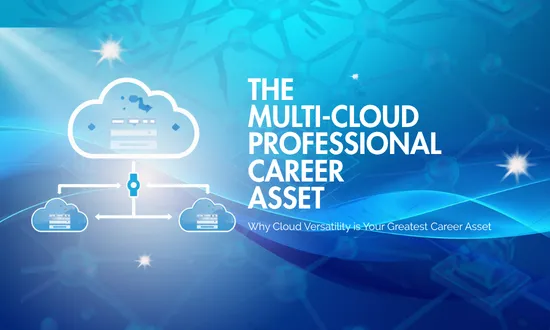
Cloud computing has changed the way modern businesses build, manage, and scale digital systems. From startups launching new apps to global enterprises running complex services, the cloud has become the backbone of technology operations. For years, many organizations focused on one major cloud provider and built their infrastructure around that single ecosystem. Today, that model is changing. More companies are adopting multi-cloud strategies, using a combination of platforms such as Amazon Web Services (AWS), Microsoft Azure, and Google Cloud to support different business goals.
This shift is also changing career opportunities. Employers are increasingly looking for professionals who understand more than one cloud environment. Instead of relying only on platform-specific knowledge, companies now value adaptability, cross-platform thinking, and architecture skills that work across providers. As a result, the multi-cloud professional is becoming one of the most valuable profiles in the modern tech workforce.
What Is a Multi-Cloud Environment?
A multi-cloud environment is a technology strategy where a company uses services from more than one cloud provider. Rather than depending entirely on a single platform, businesses spread workloads, applications, storage, and services across multiple cloud ecosystems. For example, a company may host its web applications on AWS, use Azure for enterprise integrations and identity management, and run advanced analytics or machine learning workloads on Google Cloud.
This approach does not happen by accident. It is often a deliberate business decision. Different cloud providers offer different advantages, pricing models, tools, and strengths. By combining them, organizations can choose the services that best match their technical needs, budget goals, security requirements, and long-term growth plans.
Why Businesses Are Moving Beyond One Provider
Companies are choosing multi-cloud because the digital world demands flexibility. Depending on only one provider can create limitations in pricing, performance, compliance, and innovation. Multi-cloud strategies help organizations remain agile and reduce risk.
- They can avoid being locked into one vendor’s ecosystem.
- They can select the best service for each workload.
- They can improve resilience and reduce downtime risk.
- They can meet regional compliance or data residency requirements.
- They can optimize cost by comparing providers and services.
For businesses, the goal is not complexity for its own sake. The goal is smarter cloud usage. That means they need professionals who can understand how these platforms differ, where they overlap, and how to design systems that work efficiently across them.
Why Multi-Cloud Skills Are Becoming a Career Advantage
The biggest reason multi-cloud expertise matters is because it makes a professional more versatile. A person who understands only one provider may be useful in a narrow role, but a person who can work across multiple platforms brings broader value. In a changing technology environment, flexibility often becomes just as important as specialization.
Employers increasingly want engineers, architects, consultants, and DevOps professionals who can compare services, migrate systems, and design solutions that are not tied too tightly to a single vendor. These professionals can support business strategy as well as technical delivery. They understand not just how to deploy infrastructure, but how to make cloud decisions that fit performance, cost, security, and scalability goals.
This kind of knowledge also opens more career paths. Multi-cloud professionals are relevant in roles such as cloud engineer, solutions architect, site reliability engineer, infrastructure specialist, platform engineer, and cloud consultant. In each of these roles, cross-platform awareness can make a candidate more competitive and more future-ready.
The Core Skills Behind Multi-Cloud Success
Being a multi-cloud professional does not mean mastering every single service from every provider. That would be unrealistic. Instead, it means understanding the core principles that apply across cloud environments and learning how those principles are implemented differently by each provider.
Strong multi-cloud professionals usually build knowledge in these areas:
- Cloud architecture fundamentals such as compute, storage, networking, and scalability
- Identity and access management concepts across platforms
- Security best practices, including encryption, governance, and compliance awareness
- Infrastructure as code tools like Terraform for repeatable deployments
- Containerization and orchestration using Docker and Kubernetes
- Monitoring, logging, cost control, and automation workflows
These skills are powerful because they are transferable. Once someone understands the architecture patterns behind cloud systems, moving from one platform to another becomes much easier. This creates a major long-term career advantage.
Multi-Cloud Professionals Bring Strategic Value
Technical skills are only part of the story. Multi-cloud professionals also help organizations make smarter strategic decisions. They can evaluate which provider is best for a certain workload, where costs may be reduced, and how to build systems with better resilience. They often become key contributors during digital transformation projects because they can connect technology decisions with business outcomes.
For example, a company expanding into global markets may need better geographic coverage, lower latency, or compliance with local regulations. A professional with multi-cloud awareness can recommend the most suitable combination of services and regions. Similarly, a business looking to improve disaster recovery may benefit from spreading critical systems across different providers. In both cases, cloud versatility supports business stability and growth.
How to Start Building Multi-Cloud Expertise
The best way to begin is to start with one provider and build a solid foundation. After that, expand to a second platform and compare the equivalent services. Learn how virtual machines, storage, networking, databases, and identity tools differ across environments. Hands-on learning is especially useful because it builds confidence much faster than theory alone.
Professionals can also strengthen their profile by creating small projects, testing deployments, and exploring cloud-neutral tools. Platforms change quickly, but foundational thinking stays valuable. The more a person learns to understand patterns instead of just product names, the more adaptable they become.
Certifications can support this journey, but real-world understanding matters more. Employers often care most about whether a candidate can solve problems, work across systems, and adapt to new tools with confidence.
The Future of Cloud Careers
Cloud computing is continuing to evolve, and the future belongs to professionals who can work across ecosystems rather than staying limited to one platform. Multi-cloud strategies are becoming more common because businesses want flexibility, resilience, and better decision-making. That means the demand for cross-platform cloud talent will continue to grow.
The multi-cloud professional represents a modern kind of technology expert: someone who combines technical depth with adaptability. In a world where companies need freedom to innovate and optimize, cloud versatility is more than a useful extra skill. It is a serious career asset. Professionals who invest in multi-cloud knowledge today are preparing themselves for stronger job opportunities, wider responsibilities, and greater relevance in the future of technology.
Share this article
Help others discover this article across your favorite platforms.